How to Fact Check AI: The Student’s Honest Guide to AI Hallucinations and Smarter Research
You trusted the AI. You copied the answer. Then your teacher marked it wrong — because the “fact” never existed. Sound familiar? You’re not alone, and this guide will make sure it never happens again.
To fact check AI, compare its output against authoritative sources like government websites, academic journals, or established encyclopedias. AI systems can produce confident-sounding but completely false information — a phenomenon called AI hallucination. Every claim an AI gives you should be independently verified before you use it in schoolwork, essays, or research.
Always verify AI-generated facts through at least two trusted, independent sources. Use tools like Google Scholar, official government databases, or your school library. Never submit AI responses as research without checking them first.
Knowing how to fact check AI is now one of the most important skills any student can have. Millions of students around the world are using ChatGPT, Google Gemini, Microsoft Copilot, and other AI tools every single day for homework, essays, and research projects. However, these tools have a serious problem that most students don’t know about — they can sound completely confident while being completely wrong.
Consider this real scenario: a student asks an AI to list five scholarly sources on climate change. The AI responds with five full citations, complete with author names, journal titles, and publication years. The student submits the essay. The teacher searches every source. None of them exist. This is not a glitch — it’s how AI sometimes behaves, and it has a name.
Therefore, understanding AI hallucinations explained in plain language, knowing whether AI information is accurate, and building strong digital literacy habits isn’t just a bonus skill anymore. It’s essential for academic success, personal credibility, and navigating a world increasingly shaped by AI-generated content. Let’s break it down clearly, step by step.
What Are AI Hallucinations? The Problem Every Student Must Understand
AI hallucinations explained simply: an AI hallucination happens when an artificial intelligence produces information that sounds real, looks real, and is stated with confidence — but is factually incorrect or entirely made up. The term “hallucination” comes from the idea that the AI is “seeing” something that isn’t there, much like how humans can misremember details.
So why does this happen? AI language models like ChatGPT are trained on enormous datasets of text from the internet, books, and other sources. They learn to predict what words and sentences should come next based on patterns. As a result, they can construct highly plausible-sounding responses even when they lack accurate information on a specific topic.
Think of it like a very confident student who half-listened in class. They might write a long, grammatically perfect essay full of educated guesses — but guesses are not facts. Furthermore, AI systems are not designed to “know” when they don’t know something. They keep generating text regardless.
AI hallucinations are not always obvious. Sometimes the wrong answer is surrounded by many correct ones, making it very hard to spot without checking. This is why fact-checking every AI response matters — not just the suspicious ones.
How Common Are AI Hallucinations in Student Research?
Studies conducted by universities and digital literacy organizations have found that AI tools hallucinate at meaningful rates, especially on niche academic topics, specific dates, names, statistics, and citations. In fact, hallucination rates in some tested AI models have ranged from 15% to over 40% on factual recall tasks. For students using AI for school research, that’s a significant risk to take without a plan.
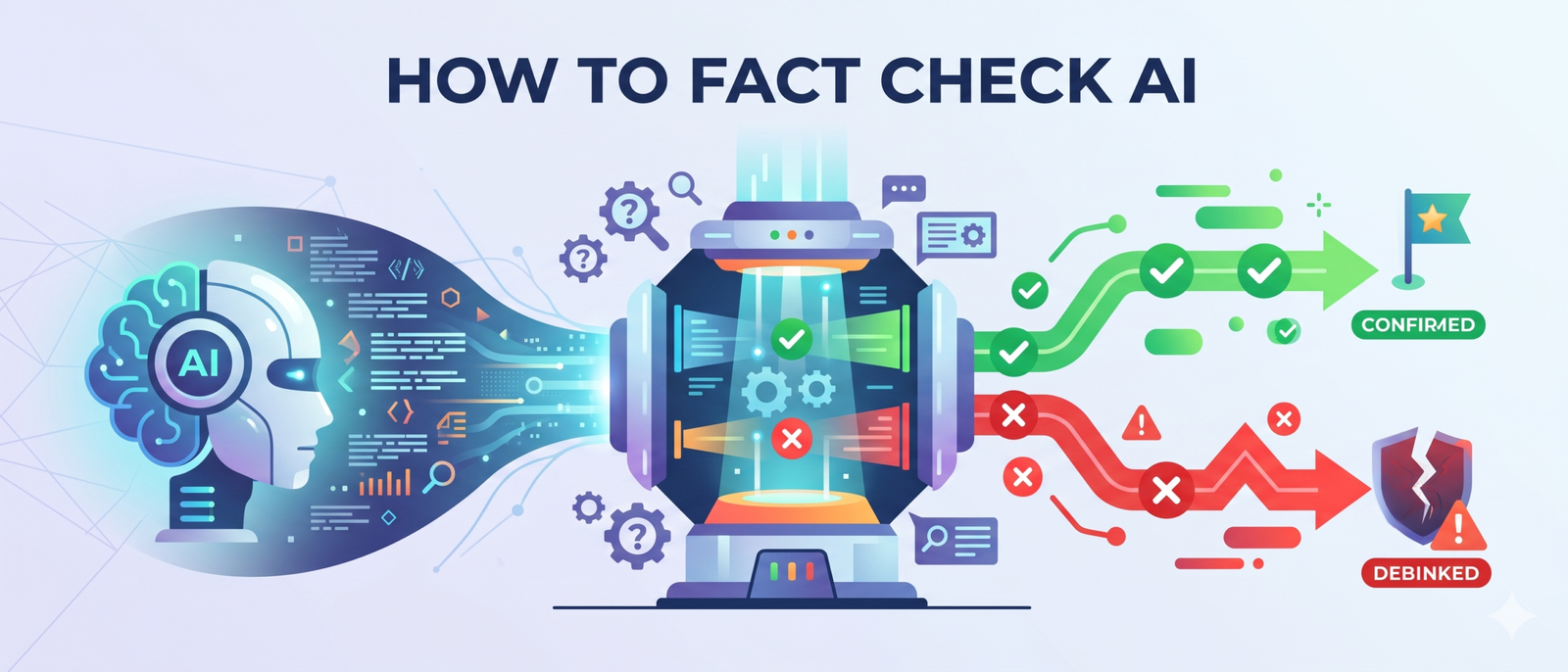
Understanding AI hallucinations is the first step to using AI safely for school research.
Is AI Information Accurate?
The honest answer to “is AI information accurate” is: sometimes yes, sometimes no — and you often can’t tell the difference just by reading it. AI tools can be remarkably accurate on broad, well-documented topics like historical timelines, basic science definitions, or general mathematical concepts. However, they become significantly less reliable when handling specific statistics, recent events, academic citations, legal information, or medical facts.
Additionally, AI tools have a training data cutoff. This means they don’t know about events that happened after a certain date. A student asking about recent news, current laws, or the latest scientific discoveries may receive outdated or incorrect information without any indication that the data is old.
What Types of AI Answers Are Most Likely to Be Wrong?
| Content Type | Accuracy Risk | Why It’s Risky |
|---|---|---|
| Academic citations & references | Very High | AI often invents author names, journal titles, and page numbers |
| Specific statistics & percentages | High | Numbers are frequently fabricated or misattributed |
| Recent news & events (post-cutoff) | High | AI has no real-time knowledge of current events |
| Medical & legal information | High | Complex domains with frequent updates AI may miss |
| Historical facts (major events) | Low–Medium | Generally more reliable but still prone to errors on specifics |
| Basic science definitions | Low | Typically accurate for well-documented, stable concepts |
| Biographical details (lesser-known figures) | High | AI can confuse or combine details from different people |
Therefore, the type of claim matters enormously. Broad conceptual definitions can often be confirmed with a quick cross-check. However, specific numbers, citations, and names always need independent verification — every single time.
How to Fact Check AI: A Step-by-Step Process for Students
Learning how to fact check AI doesn’t require advanced skills — it requires a reliable habit. Follow these steps every time you use an AI tool for school or research, and you’ll significantly reduce the risk of submitting wrong information.
- Break the AI response into individual claims. Don’t check the whole paragraph at once. Identify each distinct fact, statistic, name, or date as its own separate claim to verify.
- Identify what type of claim it is. Is it a definition, a statistic, a biographical fact, or a citation? Different claims need different verification methods.
- Search for the original source, not just confirmation. Don’t Google the AI’s words and accept the first match. Instead, search for the underlying fact directly on trusted platforms.
- Cross-reference at least two independent sources. One source confirming a fact isn’t enough. Two independent, credible sources are the minimum standard for academic research.
- Check the publication date. Even a true fact can be outdated. Always note when the source was published and whether the information might have changed.
- For citations — search the source directly. If AI gives you a journal article, search for it on Google Scholar, PubMed, or your school database. If it doesn’t appear, the citation is fabricated.
- Note what you couldn’t verify. If you can’t find a reliable source for a specific claim, don’t use it — even if the AI stated it with complete confidence.
Many educators at schools and universities recommend treating AI responses the way you’d treat an anonymous tip — interesting and potentially useful, but never usable until you’ve independently confirmed it through a credible, named source.
Best Tools to Fact Check AI Responses for School Research
The right tools make fact-checking faster and more effective. Fortunately, students have access to some excellent free resources. Many of these are the same tools that professional journalists, academics, and researchers use daily.
Academic and Research Databases(How to Fact Check AI)
- Google Scholar — Free academic search engine that indexes peer-reviewed papers, theses, and books. Use it to verify if a cited paper actually exists.
- PubMed — Run by the U.S. National Library of Medicine. Essential for verifying any health, biology, or medical claim an AI makes.
- JSTOR — A large library of academic journals, books, and primary sources. Excellent for humanities, social sciences, and history research.
- ERIC (Education Resources Information Center) — Best for education-related research and citations.
Fact-Checking Websites
- Snopes.com — One of the oldest fact-checking platforms. Good for general misinformation and viral claims.
- FactCheck.org — Monitors political and public health claims with clear sourcing.
- Reuters Fact Check — Reuters journalists investigate viral claims and news stories.
- PolitiFact — Rates the accuracy of statements from public figures and news sources.
Primary Source Databases (How to Fact Check AI)
- Government websites (.gov) — Official data on laws, statistics, health, and policy. Highly reliable for local and national information.
- World Health Organization (WHO) — Global health data and reports, freely accessible.
- United Nations Data Portal — Global statistics across economics, education, population, and more.
Additionally, SkyOasis Digital offers educational guides on digital literacy tools, media verification strategies, and responsible AI use that students and educators find valuable in navigating the AI information age.
Professional journalists operate by a “two-source rule” — no claim gets published unless confirmed by two independent, credible sources. Students who adopt this same standard when checking AI responses will immediately produce more reliable, more trustworthy academic work. It’s not about distrust of AI — it’s about professional standards of accuracy.
Students who use verified databases alongside AI tools produce significantly more accurate research outcomes.
Using AI for School Research the Right Way
Using AI for school research isn’t inherently problematic — the problem is how students use it. Many students make the mistake of treating AI as a finished source rather than a starting point. This distinction matters enormously, both academically and intellectually.
Think of AI like a very well-read research assistant who has read millions of books but can’t always remember every detail perfectly. You wouldn’t submit your assistant’s summary as your final paper. Instead, you’d use their notes to guide your own deeper reading and verification.
The Right Way to Use AI in Research
- Use AI to brainstorm research angles, not to state final facts.
- Ask AI to suggest relevant search terms and subtopics, then research those independently.
- Use AI to help you understand complex concepts in simpler language, then verify the explanation.
- Ask AI for a list of possible sources, then manually confirm each one exists and is credible.
- Use AI to help structure your essay outline, not to write the factual body content.
What About Using AI for Quoting and Citations? (How to Fact Check AI)
This is where students most often get into trouble. Never use an AI-generated citation without manually checking that the source exists and says what the AI claims it says. Instead, find the real source yourself, read it, and create your own citation. AI-generated citations are one of the most common forms of AI hallucination, and teachers are increasingly aware of this issue.
Submitting AI-generated fake citations, even unknowingly, can be treated as academic dishonesty at many institutions. Always verify every citation independently. If you can’t find the source, don’t cite it — period.
Can Teachers Detect Fake AI Facts?
Can teachers detect fake AI facts? The short answer is: increasingly, yes. However, the more important question is whether students understand why accurate information matters beyond just avoiding detection. Teachers and professors in 2026 are better equipped than ever to spot AI-generated misinformation in student work.
How Teachers Are Catching AI Hallucinations in Student Work
- Verifying citations directly — Any teacher who searches a cited journal article and finds it doesn’t exist will immediately know the source was fabricated.
- Cross-referencing statistics — Experienced educators recognize when numbers don’t align with known data and will search for the original source.
- Using AI detection tools — Platforms like Turnitin now include AI detection and hallucination flagging features that analyze content patterns.
- Noticing anachronisms — If a student cites a 2023 study but references events from 2025, or vice versa, inconsistencies stand out clearly.
- Asking follow-up questions — A student who can’t explain a source or fact they cited is a clear signal the information wasn’t genuinely researched.
Beyond detection, however, the deeper reason to build strong fact-checking habits is credibility. Students who consistently produce accurate, well-sourced work build a reputation for intellectual integrity that carries real advantages — in further education, in internships, and in professional careers.
Digital Literacy for Students (How to Fact Check AI:)
Digital literacy for students in 2026 means much more than knowing how to type a good search query. It means understanding the sources of information you consume, evaluating the credibility of platforms, and critically questioning even the most confident-sounding outputs — including those from AI.
Schools and universities across the world are increasingly embedding media literacy and AI literacy into their curricula. Organizations like the News Literacy Project, the Stanford History Education Group, and the International Literacy Association provide free tools and frameworks that teach students to evaluate digital sources systematically.
Five Daily Habits That Build Strong AI Literacy (How to Fact Check AI)
- Pause before you copy. Every time you want to use an AI response, pause and ask yourself: “Do I know this is accurate, or do I just think it sounds right?”
- Follow the source chain. Always try to find the original primary source for any fact — not just a website that repeats it.
- Look for consensus. A fact supported by multiple independent, credible sources is far more reliable than one found on a single site or AI response.
- Check the date. Information has a shelf life. Always confirm that a source is recent enough to be relevant to your topic.
- Ask your librarian. School and public librarians are expert researchers who can guide you to the best verified sources for any topic — and it’s completely free.
Frequently Asked Questions (How to Fact Check AI:)
Understanding AI Hallucinations
What is an AI hallucination and why does it happen?
An AI hallucination occurs when an AI language model generates information that is factually incorrect, misleading, or entirely invented. It happens because AI systems predict text based on statistical patterns — not factual understanding. When the model encounters a gap in its training data, it may “fill in” that gap with plausible-sounding but false information, rather than admitting it doesn’t know.
How often do AI tools like ChatGPT get facts wrong?
Hallucination rates vary by AI model and task type. Research has found error rates ranging from around 15% to over 40% on specific factual recall tasks, particularly for citations, statistics, and biographical details about lesser-known subjects. Broader conceptual questions tend to produce more reliable answers, while specific or niche facts carry a much higher risk of error.
Can AI hallucinations look convincing?
Yes — this is what makes AI hallucinations particularly dangerous for students. The AI doesn’t flag incorrect answers differently from correct ones. Fabricated citations appear with real-looking journal names, volume numbers, and page ranges. Made-up statistics arrive with specific decimal points and source attributions. Without independent verification, it is often impossible to distinguish a hallucination from a genuine fact just by reading it.
How to Fact Check AI: for School and Research
What is the best way to fact check AI for a school essay?
The best approach is to treat every specific claim in an AI response as unverified until proven otherwise. Break the AI’s output into individual facts, then search for each one using credible sources like Google Scholar, government databases, or your school’s academic library. Always find at least two independent sources that confirm the same information before using it in your work.
Is it okay to use AI for school research at all?
Using AI as a research aid — to brainstorm, understand concepts, or explore search directions — is generally acceptable and increasingly common. The critical rule is to never treat AI output as a final source. Use it as a starting point, then verify everything through credible, citable sources. Many teachers and professors now explicitly permit AI-assisted research while requiring students to independently verify and cite all information used.
How do I check if an AI-generated citation is real?
Search for the citation directly on Google Scholar, PubMed, or your school library database using the exact title and author name. If the paper exists, it will appear in the database results. If you cannot find it anywhere, assume the citation is fabricated. Never cite a source you cannot independently locate, read, or at minimum verify as existing.
What free tools can students use to verify AI information?
Google Scholar and PubMed are excellent free tools for verifying academic claims. For general fact-checking, Snopes, FactCheck.org, and Reuters Fact Check cover a wide range of topics. Government websites ending in .gov provide highly reliable official data. Your school or public library often provides free access to premium academic databases like JSTOR, which are invaluable for research verification.
Teachers, Detection, and AI in Education
Can teachers tell when a student has used AI-generated fake facts?
Yes, and increasingly so. Teachers can verify citations directly, cross-reference statistics against known data, and use AI detection platforms like Turnitin that now flag not just AI writing but also potential hallucinated content. Additionally, an experienced teacher who asks a student to explain or expand on a cited fact can quickly determine whether the student actually read and understood the source material.
What happens if a student unknowingly submits a fake AI citation?
Even unintentional submission of fabricated citations can carry serious academic consequences, depending on the institution’s policies. Many schools treat any false citation — intentional or not — as a form of academic dishonesty. The best protection is a consistent habit of verifying every source before use, so you always know for certain that what you cite actually exists and says what you claim.
How are schools teaching students to use AI responsibly?
Schools and universities worldwide are integrating AI literacy into their curricula through dedicated modules, updated academic integrity policies, and partnerships with organizations like the News Literacy Project and Common Sense Media. Many educators now teach fact-checking AI responses as a core research skill, alongside traditional source evaluation. The goal is critical thinking — not banning AI, but using it wisely and responsibly.
Ready to Grow Your Digital Presence?
Whether you need a powerful website, stunning designs, or a winning social media strategy — our team is ready to make it happen.