Balochistan Pakistan’s Largest, Most Extraordinary Province
What Is Balochistan — And Why Does the World Need to Know?
Balochistan stands as one of the most geographically stunning and historically layered regions on Earth. However, despite its sheer size and immense strategic importance, the world often overlooks it. Therefore, this guide exists to change that — offering a definitive, deeply researched look at everything that makes Balochistan remarkable.
Located in southwestern Pakistan, Balochistan covers approximately 347,190 square kilometers. Moreover, it shares international borders with Iran to the west, Afghanistan to the north and northwest, and opens to the Arabian Sea to the south. This positioning makes Balochistan a natural crossroads of civilizations.
Furthermore, Balochistan holds the largest provincial landmass in Pakistan yet remains among the least densely populated. Its population of roughly 14–15 million people represents extraordinary ethnic, linguistic, and cultural diversity. However, the province’s challenges — economic underdevelopment, access to education, and infrastructure — are equally real and deserve honest discussion.
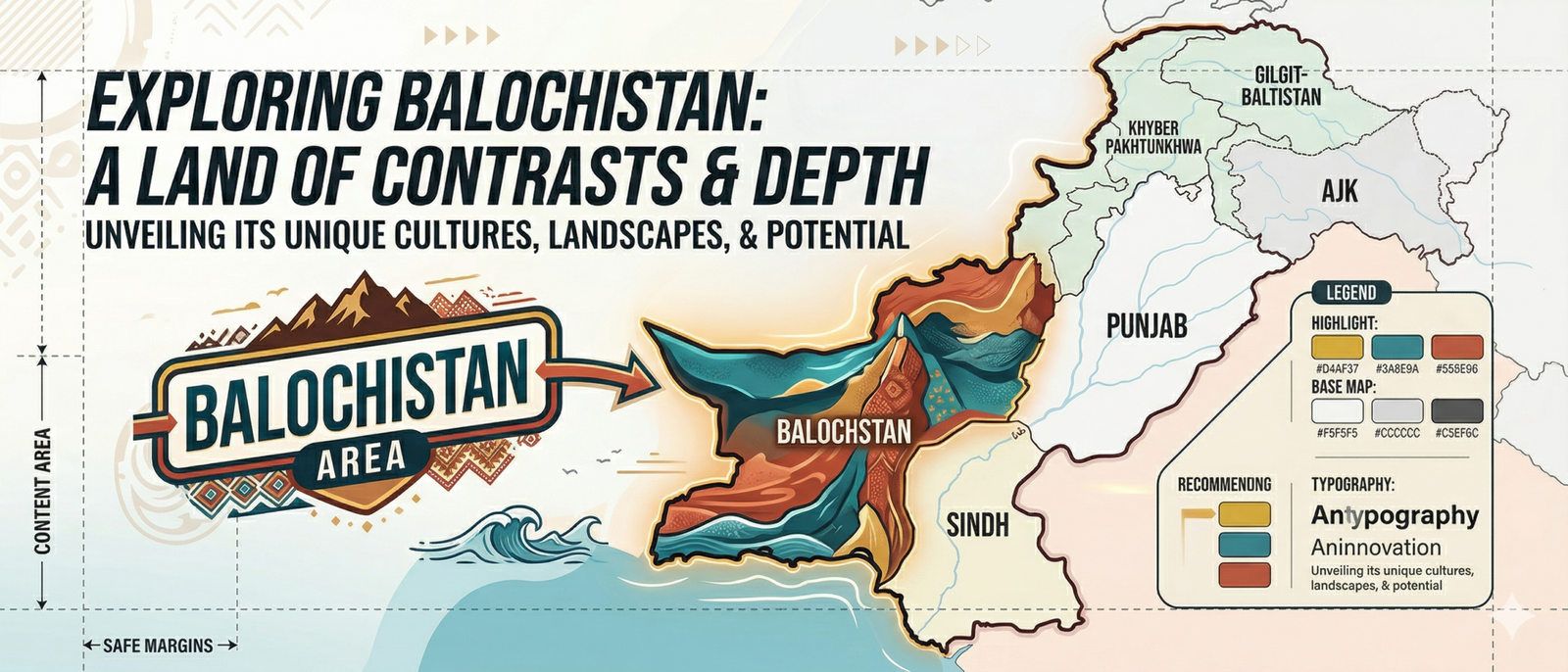
The Geography of Balochistan — Deserts, Mountains, and Sea
The geography of Balochistan is nothing short of breathtaking. Moreover, it presents one of the most diverse physical landscapes on the planet, ranging from high mountain ranges to flat coastal plains, and from scorching deserts to fertile river valleys. Therefore, geographers and travelers alike find this province endlessly fascinating.
Balochistan’s Mountain Ranges and Highlands
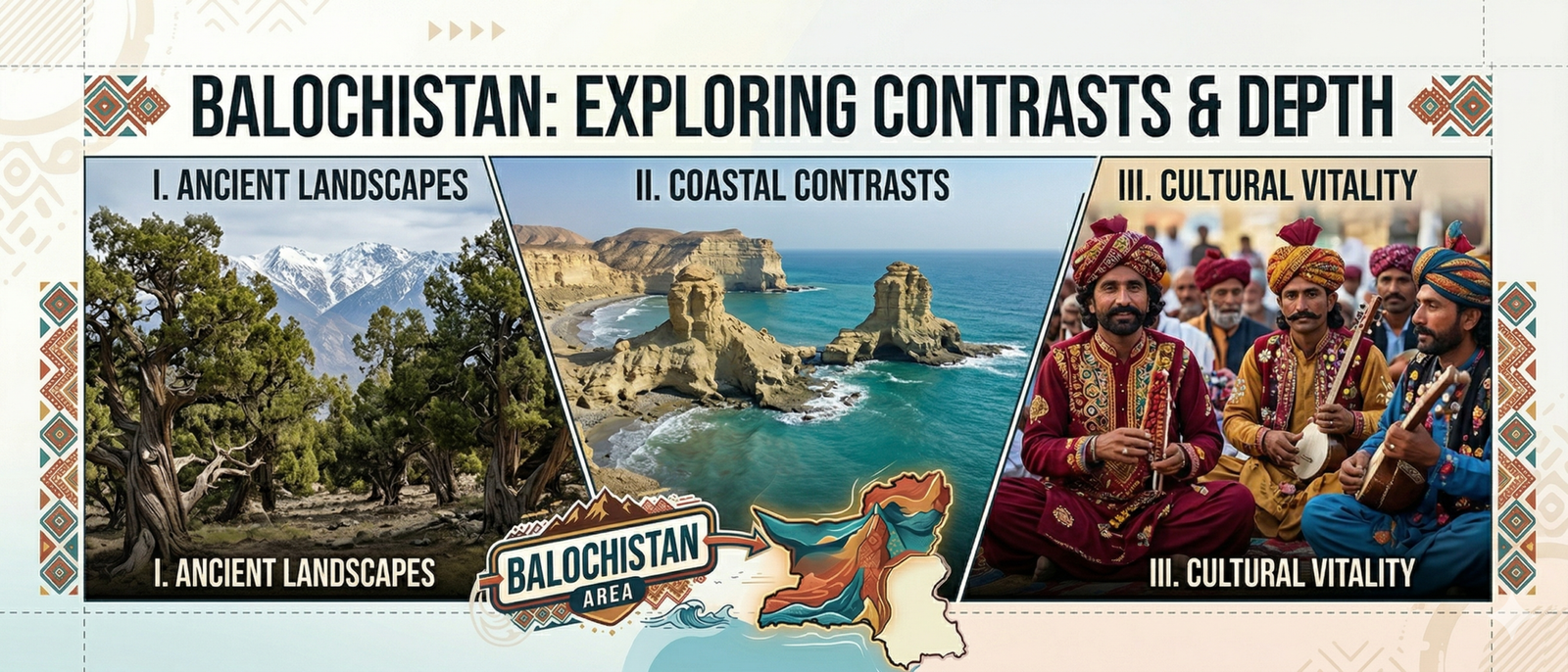
The western and northern parts of Balochistan feature towering mountain ranges, including the Sulaiman Range and the Central Brahui Range. Furthermore, Ziarat — often called the “Queen of Balochistan” — sits at 2,400 meters above sea level. However, what makes Ziarat especially unique is its ancient juniper forest, one of the oldest in the world.
Coastal Balochistan and the Makran Coast
Stretching over 700 kilometers, the Makran Coastline of Balochistan along the Arabian Sea is one of Pakistan’s most dramatic natural features. Moreover, Gwadar — a deep-sea port city — sits at the heart of this coast and has become central to the China-Pakistan Economic Corridor (CPEC). Therefore, this coastline is not only beautiful but also geopolitically significant.
Thar and Chagai Deserts
The Chagai District in northern Balochistan contains vast deserts and was notably the site of Pakistan’s 1998 nuclear tests. Moreover, the Hamun-i-Mashkel — a seasonal lake — transforms this arid landscape dramatically during monsoon rains.
Rivers and Water Resources
Balochistan’s major rivers include the Zhob, Loralai, and Dasht rivers. However, water scarcity remains the province’s most pressing geographic challenge. Therefore, karez — traditional underground irrigation channels — still sustain many rural communities today.
The Ancient and Modern History of Balochistan
The history of Balochistan stretches back thousands of years. Moreover, archaeological evidence from Mehrgarh — one of the world’s earliest agricultural settlements — places human habitation in this region as far back as 7000 BCE. Therefore, Balochistan is not merely a modern geopolitical territory; it is a cradle of ancient civilization.
Mehrgarh — One of the Oldest Settlements on Earth
Discovered in 1974 by French archaeologist Jean-François Jarrige, Mehrgarh sits in the Kachi District of Balochistan. However, what makes this site extraordinary is that it predates the Indus Valley Civilization itself. Furthermore, evidence of farming, pottery, and early dental surgery — yes, dentistry — has emerged from its excavations.
Balochistan Under the British Empire
The British formally incorporated Balochistan into their Indian empire in the late 19th century. Moreover, they divided it into British Balochistan and a collection of princely states. However, local resistance — particularly from the Khan of Kalat — never fully ceased. Therefore, the province’s relationship with central authority has deep historical roots.
Balochistan After 1947 — Independence and Integration
When Pakistan gained independence in 1947, the Khan of Kalat initially declared independence. However, Balochistan ultimately acceded to Pakistan in March 1948. Furthermore, the province achieved full provincial status only in 1970. Therefore, its modern political identity is relatively recent, even as its cultural identity stretches back millennia.
Historical Fact: Mehrgarh in Balochistan is among the earliest known sites of farming and herding in South Asia, predating the Indus Valley Civilization by over 3,000 years. Moreover, archaeologists have found evidence of cotton cultivation and bead-making that shaped ancient trade routes.
Culture and People of Balochistan — A Rich Mosaic
The culture of Balochistan is a living tapestry woven from Baloch, Brahui, Pashtun, Hazara, and many other ethnic identities. Moreover, each community brings its own language, music, dress, and traditions, creating a province that is culturally one of the most diverse in all of Asia. Therefore, understanding Balochistan’s people is inseparable from understanding its identity.
Languages Spoken in Balochistan
Balochi is the primary language of the Baloch people and belongs to the Northwestern Iranian language family. Furthermore, Brahui — a Dravidian language — is linguistically unique for its isolated presence in a sea of Indo-Iranian languages. Moreover, Pashto, Sindhi, and Urdu are widely spoken across different parts of the province.
Traditional Baloch Music and Poetry
Baloch culture places profound value on oral poetry, storytelling, and music. Moreover, the Sorud — a traditional Baloch instrument — carries centuries of musical heritage. Furthermore, poets like Jam Durrak and Sayad Hashmi are revered as cultural pillars. However, modernization and displacement have created new challenges for preserving these traditions.
Baloch Dress and Embroidery
Baloch women are renowned for their extraordinary embroidery — called “Balochi Needlework.” Moreover, this intricate craft adorns clothing, shoes, and household items with vivid geometric patterns. Therefore, Balochi embroidery has gained international recognition as a genuine art form.
Festivals and Celebrations
The Sibi Festival is one of Balochistan’s most celebrated annual events, showcasing livestock, traditional sports, and cultural performances. Furthermore, Eid celebrations, Nowruz (Persian New Year), and local harvest festivals reflect the province’s diverse religious and cultural calendar.
Balochistan‘s Economy — Natural Wealth and Untapped Potential
Balochistan is Pakistan’s richest province in terms of natural resources, yet paradoxically remains its least economically developed. Moreover, this contradiction sits at the heart of the province’s contemporary challenges. Therefore, understanding Balochistan’s economy requires looking beyond surface-level statistics.
Mineral Resources of Balochistan
The province holds enormous deposits of natural gas, coal, copper, gold, silver, and chromite. Moreover, the Saindak Copper-Gold Project and the Reko Diq Mining Project represent two of the largest untapped mineral deposits in the world. However, political instability and governance issues have historically slowed their full development.
| Resource | Key Location | Significance |
|---|---|---|
| Natural Gas | Sui, Dera Bugti | Supplies ~50% of Pakistan’s gas needs |
| Copper & Gold | Reko Diq, Chagai | One of the world’s largest deposits |
| Coal | Shahrig, Chamalang | Major domestic energy source |
| Chromite | Muslim Bagh, Khuzdar | Key export mineral |
| Fisheries | Makran Coast, Gwadar | Substantial export potential |
CPEC and Gwadar — Balochistan’s Strategic Future
The China-Pakistan Economic Corridor (CPEC) has positioned Gwadar — a port city in Balochistan — as one of the most strategically important locations in Asia. Moreover, Gwadar Port connects Central Asian trade routes to the Arabian Sea. Therefore, global economists and geopolitical analysts increasingly view Balochistan as a future economic hub.
Agriculture and Livestock
Despite its arid climate, Balochistan produces a significant share of Pakistan’s fruits, including apples, grapes, pomegranates, and dates. Moreover, the province is a major livestock producer, with millions of sheep, goats, and camels. However, water scarcity and outdated irrigation remain the sector’s biggest limitations.
Tourism in Balochistan — Hidden Wonders of the World
Balochistan offers some of the most extraordinary and least-visited natural attractions on Earth. Moreover, for adventurous travelers seeking raw landscapes untouched by mass tourism, this province is an extraordinary destination. Therefore, global tourism experts increasingly list Balochistan among the world’s great undiscovered frontiers.
Hingol National Park — Balochistan’s Crown Jewel
Covering over 6,100 square kilometers, Hingol National Park is Pakistan’s largest national park — and it sits entirely within Balochistan. Moreover, it features the astonishing Princess of Hope rock formation, the sphinx-like Balochistan Sphinx, and the mystical Kund Malir beach. Furthermore, the park hosts critically endangered species including the marsh crocodile and Balochistan bear.
Ziarat Valley — The Juniper Forest Sanctuary
Ziarat’s ancient juniper forest is believed to be over 5,000 years old, making it one of the oldest living forests in the world. Moreover, the cool climate and serene valleys make Ziarat a beloved retreat. However, climate change now threatens this irreplaceable natural heritage. Therefore, conservation efforts have become increasingly urgent.
Quetta — Capital City
Quetta, the provincial capital, sits at 1,680 meters above sea level and offers a vibrant bazaar culture, stunning mountain backdrops, and the famous Hanna Lake. Moreover, the city’s Hazarganji-Chiltan National Park is home to rare Chiltan wild goats found nowhere else on Earth.
Kund Malir and Ormara Beaches
Kund Malir Beach is consistently rated among Pakistan’s most beautiful beaches, featuring pristine sands and towering rocky cliffs. Furthermore, Ormara offers spectacular views of the Arabian Sea. However, limited tourist infrastructure means visitors must plan carefully before traveling.
Education and Development in Balochistan — Challenges and Progress
Balochistan faces some of Pakistan’s most serious development challenges. However, framing the province only through its difficulties misses the remarkable resilience and progress its communities demonstrate every day. Moreover, government and international development initiatives are steadily gaining ground. Therefore, the picture is complex — and honest assessment demands acknowledging both sides.
Literacy and Education Access
Balochistan’s literacy rate — approximately 44% — remains the lowest among Pakistan’s provinces. Moreover, girls’ education faces particular barriers in rural and tribal areas. However, organizations like the Balochistan Education Foundation and international NGOs have expanded access to schooling meaningfully in recent years. Furthermore, scholarships for higher education have increased provincial university enrollment.
Infrastructure and Connectivity
Road connectivity across Balochistan has historically been limited given its vast geography. Moreover, CPEC-linked projects have accelerated highway development significantly. However, electricity access and internet connectivity in remote districts remain pressing concerns. Therefore, digital inclusion is a central goal of provincial development plans.
Key Insight: Despite economic hardship, Balochistan’s youth are among the most entrepreneurially motivated in Pakistan. Moreover, diaspora communities in Karachi, Lahore, and abroad invest meaningfully in the province’s future. Therefore, the province’s human capital — its greatest resource — continues to grow.
Frequently Asked Questions About Balochistan
These questions answer what the world most commonly asks about Balochistan — from geography to culture, tourism to politics. Moreover, each answer reflects verified, factual information.
Geography and Basic Facts
History, Culture, and Society
Economy, Tourism, and Development
Explore More — Work With Sky Oasis Digital
Moreover, if this guide has demonstrated the power of expertly crafted SEO, GEO, and AEO content — we help brands and businesses achieve exactly this kind of visibility. Therefore, connect with us today through Sky Oasis Digital.